
Your peptide fridge does one job: hold 2–8 °C every hour of every day. Most countertop "mini fridges" you find at Walmart or on Amazon's first page do not. They're thermoelectric coolers — they pull about 18–22 °F below room temperature and stop there. In a 72 °F room that means the inside sits at ~50–55 °F. For wine, fine. For tirzepatide, BPC-157, or compounded GLP-1, that's outside spec the entire time the unit is running.
The fix is a compressor mini fridge — the same cooling mechanism your kitchen refrigerator uses, just scaled down. Compressor units actively pump heat out and can hold a stable 36–40 °F regardless of room temperature. Below are five that fit under $400, plus the buying criteria that actually matter for peptide storage.
Compressor vs thermoelectric — why it matters
Pharmaceutical labeling for refrigerated injectables (GLP-1 pens, compounded vials, TRT, peptides) almost universally specifies 2–8 °C (36–46 °F). Anything warmer accelerates degradation. Anything colder risks freezing, which destroys efficacy on most peptide formulations.
- Thermoelectric (Peltier) coolers offer a fixed temperature drop from ambient. They're cheap, silent, and lightweight — but in a warm room they cannot reach the 2–8 °C window. They also struggle in humid summer conditions.
- Compressor mini fridges run a small refrigerant loop with a thermostat. They reach 2–8 °C in 30–90 minutes, hold it within ±1–2 °C, and recover quickly after a door open. They cost more ($150–400 for a quality 1–3 cu ft unit) and make a small hum, but for peptide storage they are the only correct choice.
Buying criteria for a peptide-grade mini fridge
- Compressor cooling — non-negotiable. If the product page doesn't say "compressor," assume thermoelectric.
- Temperature range that includes 36–46 °F. Some models bottom out at 39 °F (fine) or 32 °F (avoid freezing risk).
- Adjustable digital thermostat, ideally with 1 °F increments and a digital readout.
- Glass-front or solid-door — solid door insulates better; glass-front is nice for shop displays or accountability.
- Auto-defrost — prevents ice buildup that throws off temperature.
- Quiet operation — under 40 dB for bedroom placement.
- Door alarm — bonus, but useful if the unit lives somewhere you forget to check.
The five picks under $400 (2026)
1. Best overall — Newair NRF031BK00 3.1 cu ft
True compressor cooling, digital thermostat from 33–60 °F, holds ±1 °F when set to 39. Solid door, auto-defrost, ~40 dB. Holds 50+ 3 mL vials comfortably with room for BAC water and an ice pack for travel. Around $280.
Shop Newair compressor mini fridges on Amazon Prime →
2. Best small footprint — Cooluli Concord 20-Can Compressor
1.6 cu ft compressor fridge in a 1.0 cu ft countertop footprint. Adjustable 36–50 °F, sub-30 dB, glass front. Fits 25–30 3 mL vials. Great for a bedroom or office. Around $230.
Shop Cooluli on Amazon Prime →
3. Best budget compressor — Antarctic Star 1.6 cu ft
The cheapest legitimate compressor option that stays in spec. Range 32–50 °F, digital thermostat, solid door. Holds 30+ 3 mL vials. ~$179 — half the price of the Newair, slightly louder, but it works.
Shop Antarctic Star on Amazon Prime →
4. Best glass-front — Frestec 1.6 cu ft Beverage Cooler
Glass-front compressor unit marketed as a beverage cooler, but the 36–61 °F range and stable hold make it ideal for visible peptide inventory at a clinic or med spa. ~$220.
Shop Frestec on Amazon Prime →
5. Best capacity under $400 — Whynter BR-091WS 90-Can
3.0 cu ft compressor unit, 30–60 °F adjustable, glass front, locking door (rare and useful for clinics). Stores 100+ 3 mL vials or 30+ 10 mL vials with BAC water and syringes. ~$380.
Shop Whynter on Amazon Prime →
How to set up your mini fridge for peptides
- Plug it in and let it cool for 4–6 hours empty before loading vials. Compressors take time to stabilize.
- Set the thermostat to 39 °F (4 °C). That's the dead center of the 2–8 °C window and gives you 5 °F of buffer in either direction.
- Place a separate temperature logger inside (Govee, SensorPush, or use a case with a built-in sensor like TempView). The fridge's own readout is just the ambient — vials experience whatever the door-opening pattern allows.
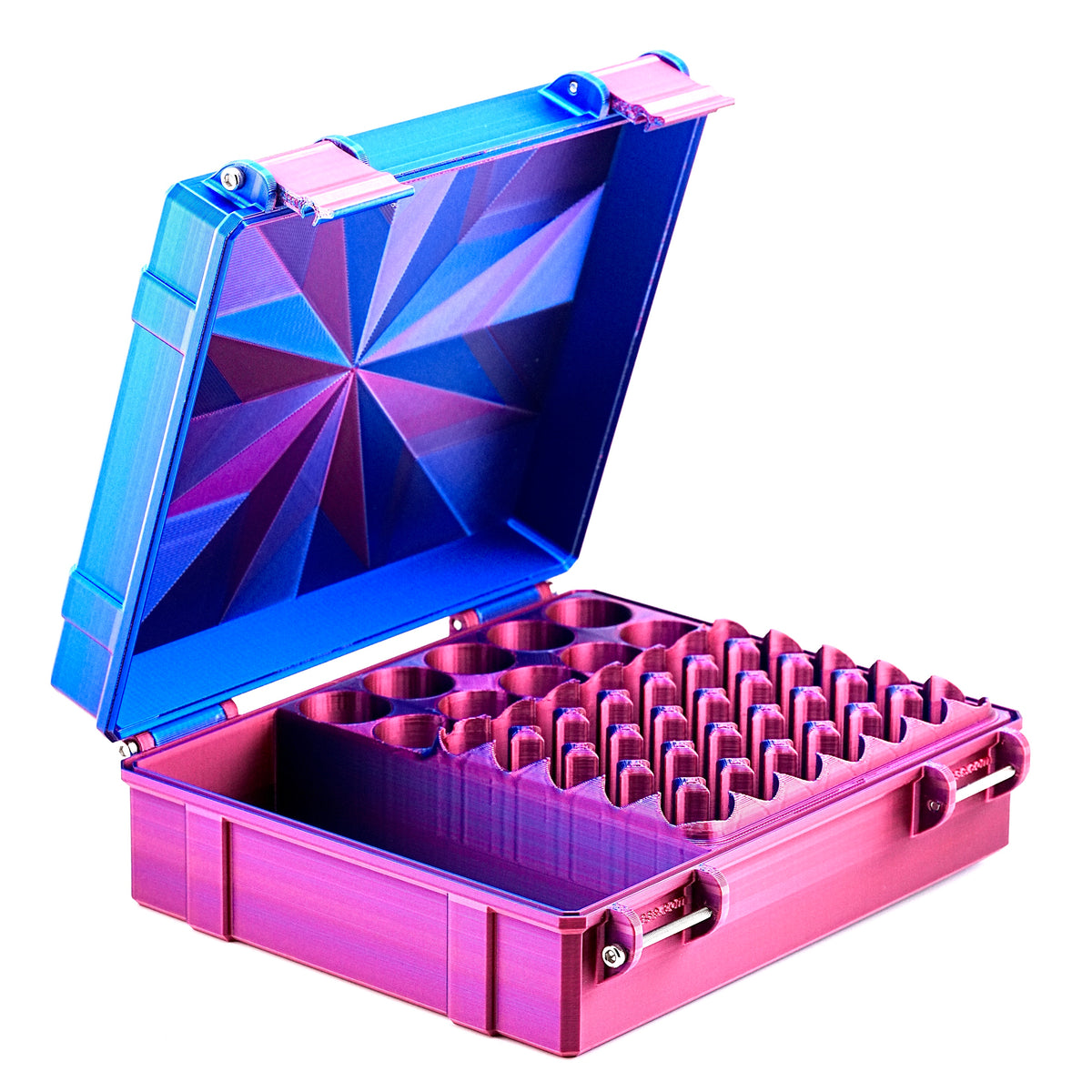
- Organize vials in a hard-shell case so they don't roll, freeze against the back wall, or sit in condensation puddles. A Vial Vault Pro Max sits inside any of the units above with room to spare.
- Avoid the door shelves — those are the warmest spots in any fridge. Keep peptides on a center shelf.
Common mistakes
- Buying a thermoelectric "mini fridge" because it's $79. It will not hold 2–8 °C. Refund and upgrade.
- Setting the thermostat to "coldest" — risks freezing peptides against the back wall.
- Storing vials directly on metal shelves — condensation pools and labels peel.
- Putting the fridge in a hot garage — even compressors struggle above 90 °F ambient.
- Trusting the dial without verification — always run a separate logger for the first week.
Pair with the right storage case
A mini fridge keeps your vials cold; a vial case keeps them organized, protected from drops, and ready to travel when needed. The combination matters:
- Vial Vault Pro Max — dual-size combo case for stacks (35–56 vials).
- TempView — case with built-in sensor for verification.
- Full collection — by vial size and slot count.
Related reading
- Best Mini Fridges for Medication Storage — 2026 Buyer's Guide
- How to Store Bacteriostatic Water Safely
- Signs a Peptide or GLP-1 Has Gone Bad
Frequently Asked Questions
What temperature should I set my peptide mini fridge to?
Set the thermostat to 39 °F (4 °C). That sits in the dead center of the 2–8 °C window most peptide labels specify and gives you a 5 °F buffer in either direction before the fridge would drift out of spec.
Why is a thermoelectric mini fridge not safe for peptides?
Thermoelectric coolers can only pull about 18–22 °F below room temperature. In a 72 °F room they reach ~50–55 °F, which is well above the 8 °C ceiling for refrigerated injectables. They also struggle in humid conditions and have no closed-loop temperature regulation.
How do I tell if a fridge is compressor or thermoelectric?
The product page should explicitly say "compressor cooling." Other clues: weight (compressor units are heavier, 25+ lbs for 1.6 cu ft), audible hum (vs silent), and digital thermostat with a real temperature range. If price is under $90 for a 1+ cu ft unit, it is almost certainly thermoelectric.
Can I store reconstituted GLP-1 vials in a wine fridge?
Yes — wine fridges use the same compressor cooling as kitchen refrigerators. Set the lower (or single) zone to 40 °F. Dual-zone units work great for peptides + BAC water at different temperatures. See our wine fridge comparison for picks.
Do I need a temperature logger inside the fridge?
Yes, at least during the first week of setup. The fridge's built-in display reflects ambient air temperature; a separate logger (or a case with built-in sensor like TempView) verifies what the vials actually experience between door openings.
Where in the fridge should I keep my vials?
Center shelves, not door shelves. Door shelves are the warmest part of any fridge and swing temperature with every door open. Keep peptides organized in a hard-shell case (Vial Vault Pro Max or similar) on a center shelf, away from the back wall where condensation can pool.
Affiliate disclosure: VialCase is a participant in the Amazon Services LLC Associates Program. As an Amazon Associate, VialCase earns from qualifying purchases at no additional cost to you. Trademarks: All brand names and product names referenced (including but not limited to Ozempic®, Wegovy®, Mounjaro®, Zepbound®, and any device or supplement brand mentioned) are the property of their respective owners and are used here for editorial identification only. VialCase is not affiliated with, endorsed by, or sponsored by these brands.
Educational only. Storage requirements vary by formulation — confirm with your prescribing healthcare provider.


