Italy with GLP-1 & Peptides: Schengen Customs, Hotels, Trains, and Mediterranean Heat (2026)
Updated on: 2026-05-08
Table of Contents
🧮 Plan dose dates around your Italy trip
Italy trips often span 7–14 days. The free GLP1 Calculator's Titration Schedule maps weekly doses across your itinerary — useful for arrival and departure timing.
📈 Track your weekly doses across the trip
The free GLP-1 Plotter logs each dose date and builds a plasma-level curve — useful for visualizing where each injection falls during your trip and confirming you don't miss a week.
- Schengen Area customs framework
- Italian Ministry of Health (AIFA) framework
- Major Italian airports (FCO, MXP, VCE, BLQ, NAP)
- Hotel mini-fridge profile by city
- Italian climate by region and season
- Train travel within Italy
- Mediterranean cruise embarkation in Italy
- Italian pharmacy access
- FAQ
- Disclaimer
1) Schengen Area customs framework
Italy is a member of the Schengen Area, the documented framework for free movement among 27 European countries. For GLP-1 and peptide travelers:
- Single border check on entry to the Schengen Area — arriving in Italy from the U.S. means clearing customs at the Italian airport of arrival; subsequent travel to other Schengen countries (France, Spain, Germany, Greece) does not involve additional customs.
- EU medical exemption — documented as broadly comparable to TSA's medical-liquids exemption. Prescription medications including injectable GLP-1s, syringes, BAC water, and cold packs are documented as permitted in carry-on with original packaging and prescription documentation.
- Personal-use quantity limits — documented as personal supply for the duration of the trip plus reasonable margin (typically 90 days). Quantities exceeding this may require additional declaration.
- Documentation in English — documented as accepted at major Italian airports. Italian translation is not required for personal-use prescription documentation but is referenced in some travel literature as a courtesy.
2) Italian Ministry of Health (AIFA) framework
AIFA (Agenzia Italiana del Farmaco) is the Italian Medicines Agency:
- Personal-use prescription medication documented as permitted entry with original packaging and prescription documentation (AIFA personal-use framework).
- Italian-prescribed alternatives — Ozempic and Mounjaro are documented as available in Italy. Italian retail pricing through SSN (Servizio Sanitario Nazionale) negotiated rates is documented as substantially lower than U.S. retail, though access is limited to Italian residents.
- EMA approval — Ozempic, Wegovy, Mounjaro, and Zepbound are EMA-approved (European Medicines Agency), the EU equivalent of FDA approval. Documented availability across major Italian pharmacies.
3) Major Italian airports (FCO, MXP, VCE, BLQ, NAP)
- Roma Fiumicino (FCO) — primary international gateway. Documented TSA-equivalent screening; large airport with multiple lounges including Star Alliance and SkyTeam partners.
- Milano Malpensa (MXP) — secondary international gateway, business-traveler heavy. Lufthansa, Emirates, Etihad, and other long-haul carrier hubs.
- Venezia Marco Polo (VCE) — cruise embarkation gateway for Adriatic itineraries. Smaller airport; documented similar medical-exemption protocols.
- Bologna (BLQ) — secondary regional airport.
- Napoli (NAP) — southern Italy gateway; Mediterranean cruise embarkation.
Italian airport security is documented as following EU-wide medical-exemption rules with prescription documentation. Standard practice is declaring medication at security and having original packaging available.
4) Hotel mini-fridge profile by city
Italian hotel mini-fridge availability varies substantially by property age and category:
- Rome — Marriott, Hilton, Westin, St. Regis, Hyatt, and other major chains document standard in-room refrigerators. Boutique Italian hotels (small palazzo-style properties) document refrigerators in upgraded categories; basic rooms vary.
- Florence — Four Seasons, St. Regis, Belmond, and major chains document standard refrigerators. Boutique properties (especially historic palazzi) variable.
- Venice — Belmond Cipriani, Aman Venice, Gritti Palace, and major luxury properties document standard refrigerators. Smaller historic Venetian hotels (older properties without modern HVAC retrofit) may not include refrigerators in basic categories.
- Milan — business-traveler hotels (Marriott, Westin, Bulgari, Mandarin Oriental) document standard refrigerators. Most international chains in Milan document refrigerators in all categories.
- Boutique B&Bs and Airbnbs — refrigerators often available but not guaranteed. Documented practice is confirming at booking when temperature-critical medication is involved.
5) Italian climate by region and season
- Northern Italy (Milan, Venice) — summer 78–86°F (26–30°C) typical; occasional 95°F+ heat events. Winter 30–45°F (-1–7°C); cold and damp.
- Central Italy (Rome, Florence, Tuscany) — summer 82–92°F (28–33°C); occasional 100°F+ heat events especially July/August. Winter 40–55°F (4–13°C).
- Southern Italy (Naples, Amalfi, Sicily) — summer 85–95°F (29–35°C); humid coastal heat. Winter 50–65°F (10–18°C).
Italian summer heat (July/August) routinely approaches the 86°F (30°C) ceiling for branded GLP-1 storage. Documented practice for summer Italy travel is hotel refrigerator confirmed and insulated case for sightseeing days.
6) Train travel within Italy
Italian high-speed rail (Trenitalia Frecciarossa, Italo) connects major cities. Documented considerations:
- No security screening for medication on Italian trains — carry-on is unrestricted. Medication can travel in a small bag at seat.
- Air-conditioned cabin — Italian high-speed trains are documented as climate-controlled to comfortable temperatures (~22°C / 72°F). No active cooling required during transit.
- No fridge access on trains — documented practice is keeping medication in insulated case with cold packs for routes longer than 4 hours.
- Common routes — Rome–Florence (1.5h), Florence–Venice (2h), Rome–Naples (1h), Milan–Venice (2h), Rome–Milan (3h).
7) Mediterranean cruise embarkation in Italy
Italy is a major Mediterranean cruise embarkation/debarkation hub:
- Civitavecchia (Rome's port) — primary Mediterranean cruise port. Major lines (Royal Caribbean, Norwegian, MSC, Costa, Princess, Holland America) embark here. Pre-cruise hotel stay in Rome is documented as common.
- Venice (Marittima/Fusina) — Adriatic cruise embarkation. Recent restrictions on large ships in the Venice Lagoon document changes; some cruise lines now embark from nearby ports (Trieste, Ravenna).
- Naples (Stazione Marittima) — Mediterranean cruise port for southern Italy/Greece itineraries.
- Genoa, Savona, Livorno, Bari, La Spezia — secondary cruise ports.
For documented cruise line policies, see our GLP-1 Travel Master Guide.
8) Italian pharmacy access
- Farmacia (pharmacy) — identified by green cross signs. Distributed throughout Italian cities. Documented as accepting U.S. and international prescriptions for prescription medications, with Italian medical professional review.
- Pharmacist as first medical contact — Italian pharmacy practice documents pharmacists as primary first-line medical contact for minor needs. They speak some English in tourist-area pharmacies.
- 24-hour pharmacies — major Italian cities document at least one 24-hour pharmacy. Roma Termini area, Milano Centrale, and major airport areas document overnight access.
- Italian-equivalent medications — Ozempic and Mounjaro are EMA-approved and available; Italian generic alternatives may be available for some peptides.
9) FAQ
Can I bring GLP-1 medications into Italy?
Yes. Italy's documented EU medical-exemption rules permit prescription medications including injectable GLP-1s with original packaging and prescription documentation for personal use during the trip plus reasonable margin.
Do I need Italian translation of my prescription?
Documented practice references English documentation as accepted at major Italian airports and pharmacies. Italian translation is not required for personal-use prescriptions but is sometimes referenced in travel literature as a courtesy for smaller airports or pharmacies.
Are Italian hotel mini-fridges suitable for GLP-1 storage?
Most major chain hotels in Rome, Florence, Venice, and Milan document standard in-room refrigerators suitable for the 2–8°C range needed for branded GLP-1 storage. Boutique Italian hotels and historic palazzo-style properties vary; documented practice is confirming refrigerator availability at booking.
How does Italian summer heat affect GLP-1 storage?
Italian summer (July/August) routinely approaches the 86°F (30°C) ceiling for branded GLP-1 storage in central/southern Italy. Documented practice for summer Italy travel is using hotel refrigerator as primary storage and insulated case with cold packs for sightseeing days.
What if I run out of GLP-1 medication during my Italy trip?
Italian pharmacies (farmacie) document accepting international prescriptions with Italian medical professional review. Major chain pharmacies in tourist areas document English-speaking staff. Documented practice is bringing the trip's full supply plus margin rather than relying on Italian pharmacy refill.
Trademark notice: Ozempic® and Wegovy® are registered trademarks of Novo Nordisk A/S. Mounjaro® and Zepbound® are registered trademarks of Eli Lilly and Company. Trenitalia®, Italo®, Frecciarossa®, and Italian airport codes (FCO, MXP, VCE, BLQ, NAP) are registered marks of their respective owners. AIFA (Agenzia Italiana del Farmaco) and SSN (Servizio Sanitario Nazionale) are Italian government agencies. Vialcase is independent and is not affiliated with any of the entities referenced.
Recommended Travel Cases
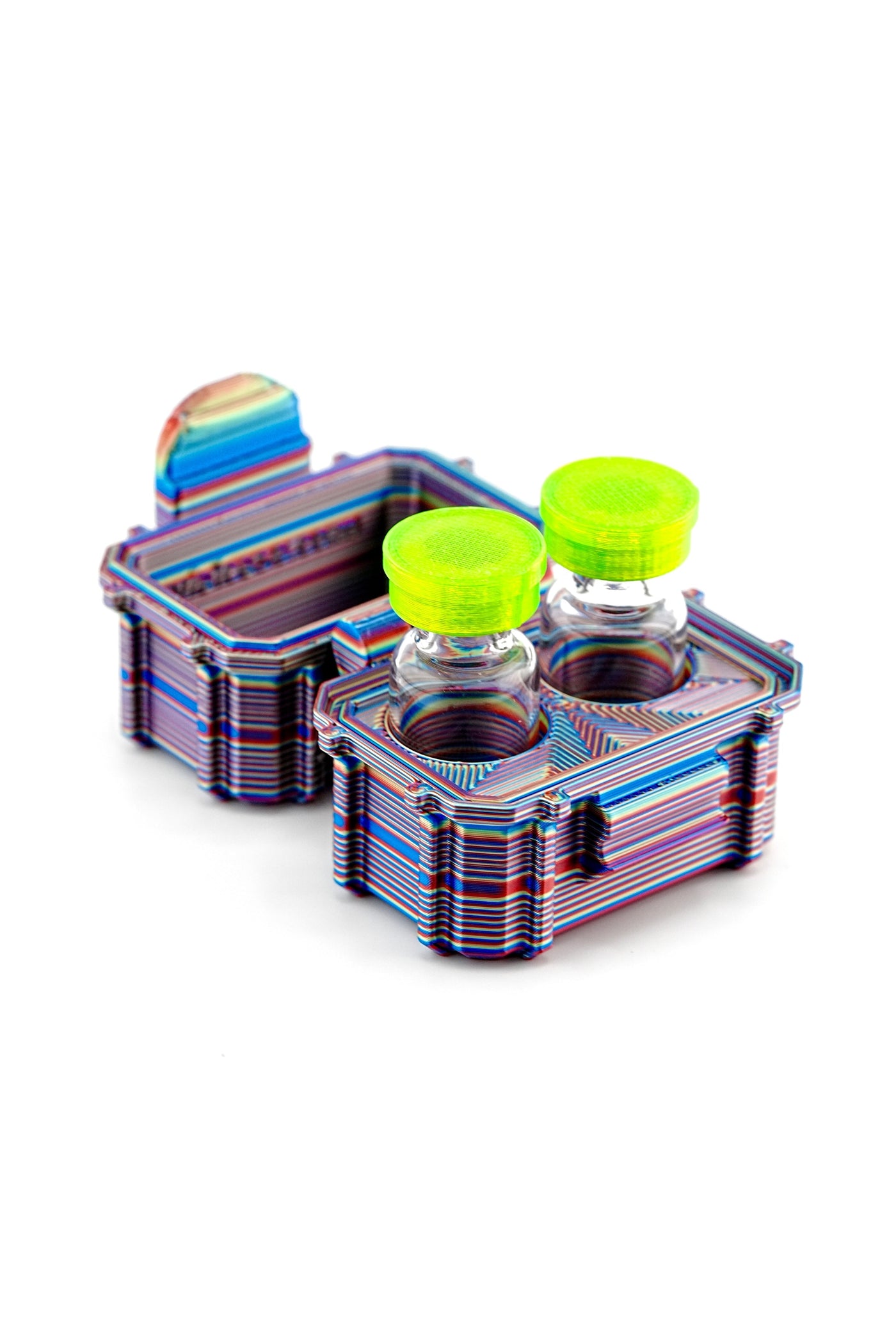
Vialcase produces hard-shell vial cases sized for GLP-1 pens, peptide vials, BAC water bottles, and reconstitution supplies. Three options most commonly referenced for travel:


Browse all vial storage cases →
Disclaimer
This article is informational reference only on documented Italy travel considerations. It is not medical or legal advice. Refer to current Italian and EU travel/customs guidance, manufacturer prescribing information, and a licensed healthcare provider for clinical guidance.
Find your perfect case
Hard-shell, dust-free storage for every vial size. Made to order and backed by our 30-day guarantee.
Shop All Cases →