
Updated on: 2026-05-08
Microdose GLP-1 Storage: How to Keep Split Vials Fresh for 8–12 Week Protocols (2026)
🧪 Plan your microdose schedule
Microdosing means 8–12 weeks of weekly micro-injections from one vial. The free GLP1 Calculator's titration tool maps every dose date so you don't miss one — useful for tracking which week of the protocol you're on.
📈 Track plasma levels across the protocol
The free GLP-1 Plotter logs each microdose and builds a plasma curve — so you can see if your weekly cycle is staying in the steady-state band you targeted.
Microdosing GLP-1s stretches one multi-dose vial across an 8–12 week protocol of small fractional weekly doses instead of finishing it in 4–5 weeks at standard titration. The dosing math gets the headlines; the storage problem gets ignored. A vial designed for 4–5 weekly draws now sees 24+ punctures, the BAC water inside it ages past its 28-day in-use window, and the peptide has to remain stable through repeated cold-warm cycles. This is an informational reference on the documented storage side of long microdose protocols. It is not medical advice and does not address dosing.
Table of Contents
- What "Microdosing" Means From a Storage Perspective
- Why Microdose Storage Is Different from Standard Dosing
- Sterility Risks: 24+ Punctures of One Stopper
- BAC Water 28-Day Window vs. 8-Week Microdose Protocols
- Refrigeration Logistics: One Vial, Eight Weeks
- When to Split into Multiple Daughter Vials
- Freeze/Thaw Damage: Why You Can't "Pause" a Reconstituted Vial
- Storage Equipment for Long Microdose Protocols
- FAQ
- Disclaimer
1) What "Microdosing" Means From a Storage Perspective
From a storage standpoint, microdosing GLP-1s isn't new pharmacology — it's a longer timeline. The same lyophilized semaglutide or tirzepatide vial that a standard-dose user finishes in roughly 4–5 weeks now has to survive 8–12 weeks of weekly use. Every variable that mattered before still matters — for longer, and with cumulative risk.
The shift in attention is what trips people up. Andy Cohen's reported microdose weight loss and the widely cited "1 in 7 Americans microdosing" figure pushed the dosing approach mainstream, while April 2026 expert commentary from Cleveland Clinic and Novant Health focused on dose-related safety. The storage side — sterility, preservative shelf-life, peptide stability, freeze-thaw exposure — is the gap. A safe dose drawn from a compromised vial isn't safe.
⚠️ The microdose storage problem in one sentence
A multi-dose GLP-1 vial designed for ~5 weekly punctures is now being asked to deliver 24+ punctures across 8–12 weeks — through a window that exceeds the diluent's labeled 28-day in-use period.
2) Why Microdose Storage Is Different from Standard Dosing
Recommended Reconstitution Setup
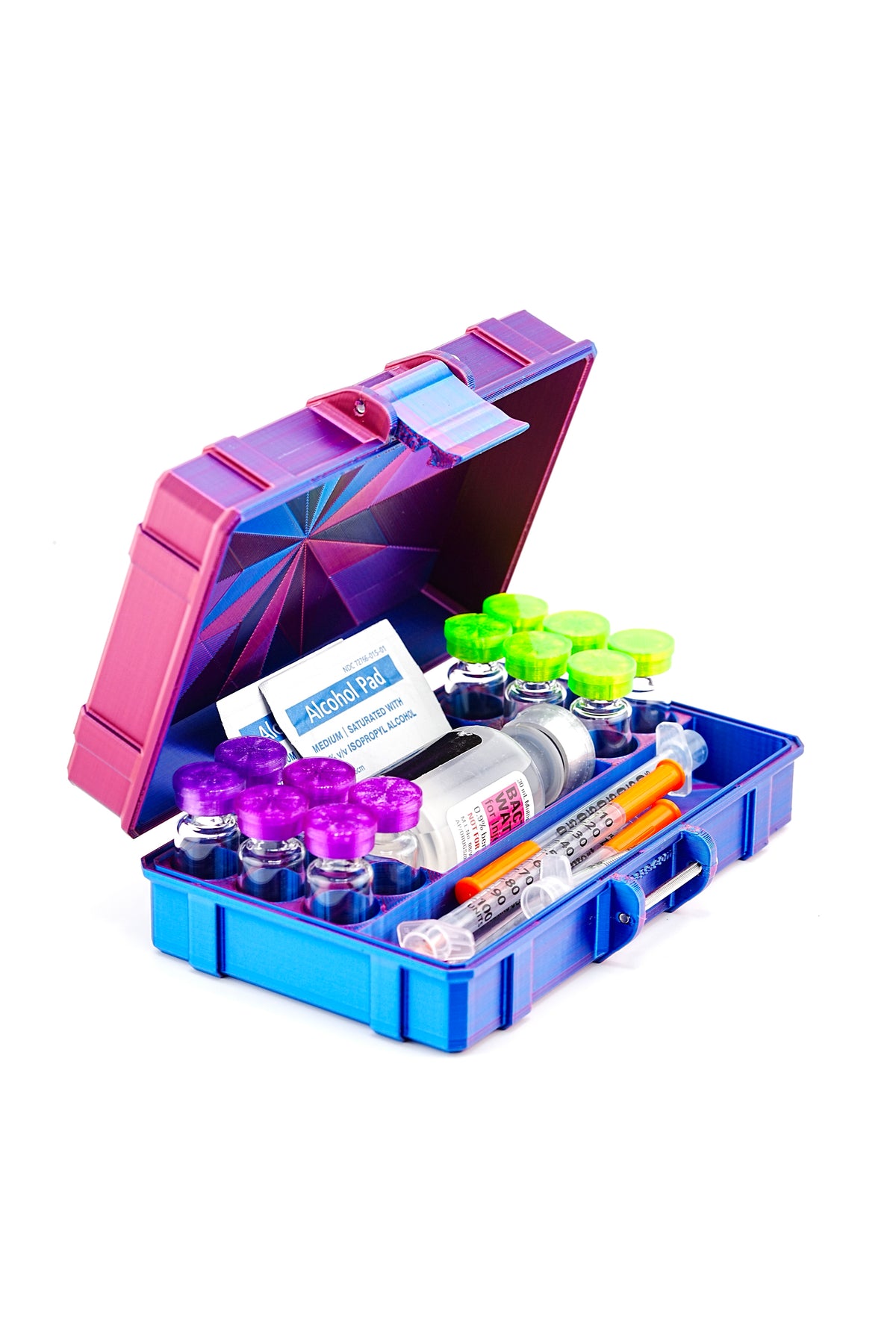
Vial Vault Pro 56
All-in-one travel-safe peptide storage case. Holds up to 56 mL of 3 mL vials, locking lid, free shipping.
Three documented factors compound on a longer protocol:
- Cumulative puncture count. Standard dosing finishes a vial in 4–5 punctures; microdose protocols stretch the same vial to 16–32+. The rubber stopper's reseal capacity is finite.
- Diluent age. Bacteriostatic water carries a labeled 28-day in-use period under refrigeration. An 8–12 week protocol exceeds that window before the vial is empty.
- Peptide stability. Reconstituted GLP-1 peptides are documented as stable across the 4–5 week window most label inserts reference. Stability data past that thins out quickly.
For a primer on the standard diluent, see BAC water vs sterile water vs saline.
3) Sterility Risks: 24+ Punctures of One Stopper
The rubber stopper on a multi-dose vial is engineered to reseal after needle withdrawal. That reseal capacity isn't infinite. Pharmaceutical literature documents two failure modes that compound across many punctures:
- Coring. A poorly inserted needle — wrong angle, dull tip, off-center — can shear off a small piece of rubber that falls into the vial. Across 24+ punctures, the cumulative coring probability is materially higher than across 4–5.
- Microbial ingress. Each puncture momentarily breaches the sterile barrier. Standard pharmacy practice — alcohol-wipe, fresh sterile syringe per draw, no double-dipping — reduces but does not eliminate per-puncture risk. Probability stacks across the protocol.
The protective factor in BAC-water-reconstituted vials is benzyl alcohol, the same 0.9% preservative that gives BAC water its 28-day window. Inside the reconstituted vial, that preservative effect is documented but is not unlimited and is also clock-bound.
✅ Documented practices that reduce per-puncture risk
- Alcohol-wipe the stopper before every draw (not just the first).
- One fresh sterile insulin syringe per draw — no reuse.
- Insert perpendicular, single clean motion, no rocking the needle.
- Visual inspection before every draw — cloudiness, particulates, color shift, off odor.
4) BAC Water 28-Day Window vs. 8-Week Microdose Protocols
Hospira's package insert for bacteriostatic water specifies a 28-day in-use period after first puncture, refrigerated. That's the manufacturer's sterility-assurance window for the diluent itself. The constraint carries through: when a peptide is reconstituted on day 1 of an 8–12 week protocol, the BAC water inside that vial is also on day 1 of its 28-day clock. By day 29, the diluent is past its labeled in-use window inside the vial — the manufacturer's sterility assurance no longer covers the timeline.
| Protocol week | Status of BAC water inside the vial | Documented reference |
|---|---|---|
| Weeks 1–4 | Within Hospira's 28-day in-use window | Manufacturer-stated, refrigerated |
| Weeks 5–6 | Just past 28-day window | Outside labeled coverage |
| Weeks 7–8 | ~2x past labeled window | Outside labeled coverage |
| Weeks 9–12 | ~3x past labeled window | Outside labeled coverage |
For background on how the 28-day clock works, see how long BAC water lasts after opening and the documented Hospira vs. compounded BAC water reference.
5) Refrigeration Logistics: One Vial, Eight Weeks
An 8–12 week microdose protocol means a single reconstituted vial occupies fridge real estate for two to three months. The documented storage profile assumes:
- 2–8°C continuous — interior shelves, away from the door (door temperatures cycle the most).
- Upright orientation with the stopper protected from contact.
- Light-protected — original carton or an opaque case. GLP-1 peptides are documented as light-sensitive.
- Stable temperature — no repeated room-temperature exposure beyond the brief out-of-fridge window during a draw.
Logistics that get harder over a longer protocol:
- Power outages. Across 8–12 weeks, the probability of a refrigeration interruption is non-trivial. A backup plan — cold-pack-equipped insulated case, plus a documented threshold past which the vial is treated as compromised — matters more on long protocols.
- Travel during the protocol. Branded GLP-1 prescribing information documents up to 21 days below 86°F (30°C) for unopened/once-pierced single-dose formats; for compounded multi-dose vials, conservative practice is to maintain the cold chain whenever feasible.
- Household interactions. A vial that lives in the fridge for 8–12 weeks gets handled, displaced, and bumped. A labeled storage box mitigates the risk.
6) When to Split into Multiple Daughter Vials
One documented mitigation in compounding-pharmacy literature is to split a freshly reconstituted vial into multiple smaller daughter vials at the start of the protocol — instead of puncturing one vial 24+ times, divide it into three or four sterile daughter vials at week 1 and only puncture one at a time.
The catch: splitting itself is a sterility-critical procedure that end users cannot safely attempt without aseptic technique, sterile filtration, and appropriate equipment. Documented elements of compounding-pharmacy splitting include:
- Class II biological safety cabinet (laminar flow hood) or equivalent ISO 5 environment.
- Sterile-filtered transfer through a 0.22µm filter.
- Sterile, depyrogenated empty vials with sterile stoppers and crimp seals.
- Beyond-use dating per USP <797> or <800> depending on the setting.
Done outside that environment, splitting introduces more contamination risk than it removes. Realistic choices for non-pharmacist users:
Realistic vial-management options for long microdose protocols
- Use one vial, accept the puncture count. Maintain rigorous aseptic technique on every draw; track puncture count and visual condition; treat the vial as compromised at any sign of cloudiness, particulates, or off odor.
- Reconstitute multiple smaller-mg vials sequentially. Where supply allows, two 5 mg vials reconstituted six weeks apart yields the same total dosing window with half the puncture count per vial.
- Have it split by a 503A/503B compounding pharmacy. Some compounders will dispense multi-vial sets explicitly for long microdose protocols. The aseptic split happens upstream, in-spec.
Reusing a single BAC water bottle to reconstitute multiple peptide vials over time is a related question with its own documented constraints — see can you reuse BAC water across multiple peptide vials.
7) Freeze/Thaw Damage: Why You Can't "Pause" a Reconstituted Vial
If a microdoser pauses for a few weeks (travel, illness, supply gap), can the reconstituted vial be frozen to "stop the clock"? The documented answer across peptide stability literature is consistent: no.
- Peptide aggregation. Freeze-thaw of reconstituted GLP-1 peptides is documented to cause aggregation — chains stick to each other and the vial walls, irreversibly reducing active concentration. The visual signal can be subtle (slight haze) or absent while potency drops.
- Stopper and seal damage. Freezing expands the solution. Documented consequences include stopper deformation, micro-cracks at the crimp interface, and seal failure on thaw.
- Preservative crystallization. Benzyl alcohol can crystallize unevenly during freeze and redissolve non-uniformly on thaw. The labeled bacteriostatic effect assumes a uniform 0.9% concentration.
- Manufacturer guidance. Eli Lilly and Novo Nordisk's prescribing information explicitly documents that frozen pens or vials are not for use, regardless of whether they thaw clear.
⚠️ The fridge-back-corner risk
Many household refrigerators run colder near the back wall and on the bottom shelf, sometimes dipping below 0°C. Documented practice is a fridge thermometer in the storage zone — not a guess — and placement on a stable interior shelf, not pushed to the back.
If a protocol pauses, the realistic path documented in compounding literature is to track the pause time as part of the in-use window, not to attempt to suspend the clock with freezing.
8) Storage Equipment for Long Microdose Protocols
Equipment that's "good enough" for a 4–5 week vial may not be good enough for an 8–12 week one. Equipment categories documented across pharmacy and patient-storage literature:
- Dedicated peptide storage case. Light-blocking, padded interior, fits multi-dose vials with the original carton. Sits on a stable interior fridge shelf for the full protocol. See our peptide storage cases.
- Fridge thermometer in the storage zone. Min/max digital thermometers cost $10–$15 and document whether the zone has dipped below 0°C overnight. On a 12-week protocol, the verification is worth the few dollars.
- Snap-on vial caps. Color-coded caps protect the stopper from incidental contact between draws and visually mark which vial is mid-protocol vs. fresh.
- BAC water organization. Microdose users typically open a fresh BAC water bottle every 28 days. See the BAC water storage reference.
- Backup cold pack and insulated pouch. For power-outage contingency and short trips. Documented cold-pack windows are typically 24–48 hours for quality medical pouches.
For long microdose protocols specifically: a vial case with light protection, padded slots, and enough capacity for the entire protocol's vials plus accessories. Browse vialcase.com peptide storage cases →
9) FAQ
Is it safe to use one GLP-1 vial for 8–12 weeks of microdosing?
The documented constraints on long-protocol single-vial use are puncture count, BAC water 28-day in-use window, and peptide stability past 4–5 weeks. None are absolute prohibitions, but each adds risk that compounds over time. Standard pharmacy practice is rigorous aseptic technique on every draw and willingness to discard a vial that shows any sign of compromise. Clinical decisions belong with a licensed prescriber.
How often should I split a vial when microdosing?
Splitting a multi-dose peptide vial is a sterility-critical procedure documented as requiring ISO 5 aseptic conditions, sterile filtration, and depyrogenated empty vials. It is not safe to perform at home. Realistic options are using one vial through the protocol, reconstituting multiple smaller-mg vials sequentially, or having a 503A/503B compounder dispense pre-split vials.
What's the freeze risk if I don't use the vial weekly?
Freezing reconstituted GLP-1 peptide is documented to cause aggregation (potency loss), stopper damage, and uneven preservative crystallization. The risk isn't only intentional freezing — household refrigerators often run below 0°C in back corners. A fridge thermometer in the storage zone is the documented mitigation.
Does microdosing extend a vial's shelf life past 28 days?
No. Drawing smaller volumes per dose does not extend either the BAC water 28-day in-use window or the peptide's stability profile. The clock starts at first puncture and runs at calendar pace regardless of dose size.
Can I keep a microdose vial at room temperature?
Branded GLP-1 prescribing information documents up to 21 days below 86°F (30°C) for unopened/once-pierced single-dose formats. For compounded multi-dose vials in long protocols, conservative practice is to maintain 2–8°C refrigeration continuously, with room-temperature exposure limited to brief out-of-fridge windows during a draw.
What's the single most important storage habit for a long microdose protocol?
Visual inspection before every draw. Cloudiness, particulates, color shift, crystals, or off odor are documented contamination signals that override any calendar date.
⚠️ Disclaimer
This article is informational reference on documented storage and stability constraints relevant to long microdose GLP-1 protocols. It is not medical advice, does not address dosing, and does not direct any specific clinical action. GLP-1 medications are prescription products; reconstitution practices, in-use windows, and storage profiles vary by manufacturer and formulation. Refer to the prescribing information for the specific product, the package insert for any diluent used, and a licensed healthcare provider for clinical decisions specific to a given protocol.
For storage cases that organize peptide vials, BAC water, syringes, and accessories across a long protocol, see our storage case collection.
Cold + organized + verified — the three things every peptide stash needs. Pair a hard-shell case with a compressor mini fridge and a temperature logger so you know your storage stays in spec, not "I think it stayed cold."


