National Parks with GLP-1 & Peptides: Lodge Fridges, Heat, and Backcountry Reference (2026)
Updated on: 2026-05-08
Table of Contents
🧮 Plan dose dates around your park trip
National park trips often span 5–14 days. The free GLP1 Calculator's Titration Schedule maps weekly doses against your itinerary.
📈 Track your weekly doses across the trip
The free GLP-1 Plotter logs each dose date and builds a plasma-level curve — useful for visualizing where each injection falls during your trip and confirming you don't miss a week.
- Shared framework across National Parks
- Yellowstone National Park
- Yosemite National Park
- Grand Canyon National Park
- Zion National Park
- Acadia National Park
- Rocky Mountain National Park
- Glacier National Park
- Death Valley National Park
- Backcountry storage considerations
- FAQ
- Disclaimer
1) Shared framework across National Parks
U.S. National Parks share documented framework elements relevant to GLP-1 and peptide travel:
- NPS lodges and concessioner-operated hotels — in-park lodging managed by Xanterra, Aramark, Delaware North, and other concessioners. Mini-fridge availability varies by lodge.
- Visitor Center medical access — most major parks document a visitor center or ranger station where minor medical situations can be addressed. Pharmaceutical-grade medication storage is typically not offered.
- Gateway-town pharmacies — most major parks have nearby gateway towns (Jackson WY, Estes Park CO, West Yellowstone MT, Springdale UT, Bar Harbor ME) with chain pharmacies for backup needs.
- Cell service variability — many park interiors have limited cell coverage. Documented practice is downloading park maps and pharmacy locations before entering the park.
- Backcountry permits — multi-day backcountry trips require permits and document specific food/medication storage rules (bear-proof containers in many parks).
2) Yellowstone National Park
Documented characteristics for Yellowstone (WY/MT/ID):
- Lodging — Xanterra-operated lodges (Old Faithful Inn, Lake Yellowstone Hotel, Mammoth Hot Springs Hotel, Canyon Lodge, Grant Village). Mini-fridges documented as available in some upgraded room categories; not standard in basic cabins. Documented practice is calling Xanterra ahead to request a refrigerator or confirm room category.
- Medical access — Yellowstone Park Service Clinic at Mammoth Hot Springs (year-round); Lake Hospital (summer-only) at Lake Village.
- Climate — daily highs 70–80°F (21–27°C) in summer; nights drop to 30s/40s. Generally favorable for medication carry.
- Gateway towns — West Yellowstone MT, Gardiner MT, Cody WY, Jackson WY (south entrance) all have chain pharmacies.
3) Yosemite National Park
Documented characteristics for Yosemite (CA):
- Lodging — Aramark-operated (The Ahwahnee, Yosemite Valley Lodge, Curry Village, Wawona Hotel). The Ahwahnee documents in-room refrigerators in deluxe rooms; standard cabins at Curry Village do not document refrigeration.
- Medical access — Yosemite Medical Clinic at Yosemite Valley (year-round).
- Climate — Yosemite Valley summer daily highs 85–95°F (29–35°C); cooler at higher elevations (Tuolumne Meadows, 8,600 ft). Direct sun on Valley Floor can push effective temperatures higher.
- Gateway towns — Mariposa, Oakhurst, Lee Vining (Tioga Pass).
4) Grand Canyon National Park
Documented characteristics for Grand Canyon (AZ):
- Lodging — Xanterra (South Rim: El Tovar, Bright Angel Lodge, Maswik, Yavapai). El Tovar and Yavapai document in-room refrigerators in upgraded categories; basic cabins at Bright Angel typically do not.
- Medical access — North Country Healthcare Clinic at South Rim.
- Climate — South Rim (7,000 ft): daily highs 78–85°F (26–29°C) summer. Inner Canyon (Phantom Ranch, 2,400 ft): daily highs 95–108°F (35–42°C) — substantially hotter than the rim.
- Gateway towns — Tusayan AZ (south entrance), Williams AZ, Flagstaff AZ.
- Phantom Ranch hike-in — documented as a destination requiring multi-day pack with stricter heat management for medication.
5) Zion National Park
Documented characteristics for Zion (UT):
- Lodging — Zion Lodge (in-park, Xanterra) documents in-room refrigerators in standard rooms. Springdale UT (gateway) has multiple hotels with documented refrigerators.
- Medical access — nearest urgent care in Springdale UT.
- Climate — daily highs 95–105°F (35–41°C) summer in the canyon. Direct sun and reflected heat off canyon walls intensify exposure.
- Gateway town — Springdale UT directly at park entrance.
6) Acadia National Park
Documented characteristics for Acadia (ME):
- Lodging — no in-park lodging at Acadia (other than seasonal campgrounds). Bar Harbor ME and surrounding communities provide accommodations with standard hotel mini-fridges.
- Medical access — Mount Desert Island Hospital in Bar Harbor.
- Climate — daily highs 70–78°F (21–26°C) summer. Coastal Maine is documented as the most favorable major park for medication temperature management.
- Gateway town — Bar Harbor ME directly at park entrance.
7) Rocky Mountain National Park
Documented characteristics for Rocky Mountain (CO):
- Lodging — no in-park lodging (Glacier Basin and Moraine Park campgrounds only). Estes Park CO and Grand Lake CO provide accommodations with documented refrigerators.
- Medical access — Estes Park Health hospital.
- Climate — daily highs 70–80°F (21–27°C) at park entrance; cooler at Bear Lake and Trail Ridge Road (12,000+ ft). Generally favorable.
- Altitude — documented practice references altitude as a separate consideration beyond temperature; medication storage is unaffected by altitude but patient hydration matters.
8) Glacier National Park
Documented characteristics for Glacier (MT):
- Lodging — Xanterra-operated historic lodges (Many Glacier Hotel, Lake McDonald Lodge, Rising Sun Motor Inn). Mini-fridges documented in upgraded room categories; not in basic motor inn rooms.
- Medical access — Logan Health hospital in Whitefish/Kalispell.
- Climate — daily highs 70–80°F (21–27°C) summer; cool nights. Favorable for medication carry.
- Gateway towns — West Glacier MT, East Glacier MT, Whitefish MT, Kalispell MT.
9) Death Valley National Park
Documented characteristics for Death Valley (CA/NV):
- Lodging — The Inn at Death Valley and The Ranch at Death Valley (Xanterra). Both document in-room refrigerators in standard rooms.
- Medical access — nearest hospital in Pahrump NV (~60 miles).
- Climate — the most extreme of any U.S. National Park. Daily highs 110–120°F+ (43–49°C+) summer; record 134°F (57°C). Documented practice strongly references against summer Death Valley travel for any temperature-sensitive medication.
- Optimal visit season — November through March, when daily highs are 65–85°F (18–29°C).
Death Valley summer is documented as the most challenging environment in the entire U.S. National Park system for medication temperature management. Documented practice for unavoidable summer visits is continuous AC in vehicle and lodging, with absolutely no parked-vehicle medication storage.
10) Backcountry storage considerations
Documented framework for multi-day backcountry trips with GLP-1 medication:
- Trip duration — the documented branded GLP-1 room-temperature window (Ozempic 56 days, Wegovy 28 days, Mounjaro/Zepbound 21 days) supports backcountry trips up to several weeks for branded pens at ambient temperatures within the 30°C ceiling.
- Compounded vials — stricter cold-chain expectation. Multi-day backcountry trips with compounded vials are documented as challenging without active cooling. Consideration of switching to branded pens for backcountry-heavy trips is documented in patient travel literature.
- Bear-proof storage — many parks require bear-proof containers for food and odor-emitting items. Documented practice references checking park-specific rules; medication is typically not classified as bear-attractant but may need to be in the bear box for the same logistical reasons as food.
- Sharps disposal in backcountry — documented practice is packing out used sharps in a small portable sharps container; never bury or leave sharps in the backcountry.
11) FAQ
Do National Park lodges have refrigerators?
It varies by park and room category. Some lodges (The Ahwahnee at Yosemite, El Tovar at Grand Canyon, the Death Valley Inn) document in-room refrigerators in standard rooms. Others (basic cabins at Curry Village, Bright Angel, motor inn categories at Glacier) do not document refrigeration. Documented practice is contacting the lodge concessioner ahead of booking to confirm refrigerator availability for medication.
Which National Park has the most challenging climate for GLP-1 storage?
Death Valley in summer documents the most extreme heat profile (daily highs routinely 110–120°F+), making medication temperature management highly challenging. The optimal documented visit season is November through March.
Can I take a long backcountry trip with my GLP-1?
Branded GLP-1 pens document substantial room-temperature flexibility (Ozempic 56 days, others 21–28 days) at ambient ≤86°F, supporting multi-week backcountry trips when ambient temperatures stay within range. Compounded vials reference stricter cold-chain expectations. Documented practice for backcountry-heavy trips is consultation with the prescribing physician about format suitability.
Where should I keep medication during a National Park day-hike?
Documented practice for day-hikes is keeping medication in an insulated case in your daypack, in shaded position when stopped. Direct sun on a daypack at high-altitude or canyon-floor parks can push internal temperatures above the storage ceiling.
Are pharmacies near National Parks?
Most major National Parks have gateway towns within 30–90 minutes with chain pharmacies (CVS, Walgreens, Rite Aid). Documented practice is mapping the nearest pharmacy location ahead of trip in case of supply emergency.
Trademark notice: Ozempic®, Wegovy®, Mounjaro®, and Zepbound® are registered trademarks of Novo Nordisk A/S and Eli Lilly and Company respectively. Yellowstone, Yosemite, Grand Canyon, Zion, Acadia, Rocky Mountain, Glacier, and Death Valley are National Parks operated by the U.S. National Park Service. Xanterra Travel Collection®, Aramark®, and Delaware North® are registered trademarks of their respective concessioners. Vialcase is independent and is not affiliated with the NPS, any park concessioner, or any pharmaceutical manufacturer.
Recommended Travel Cases
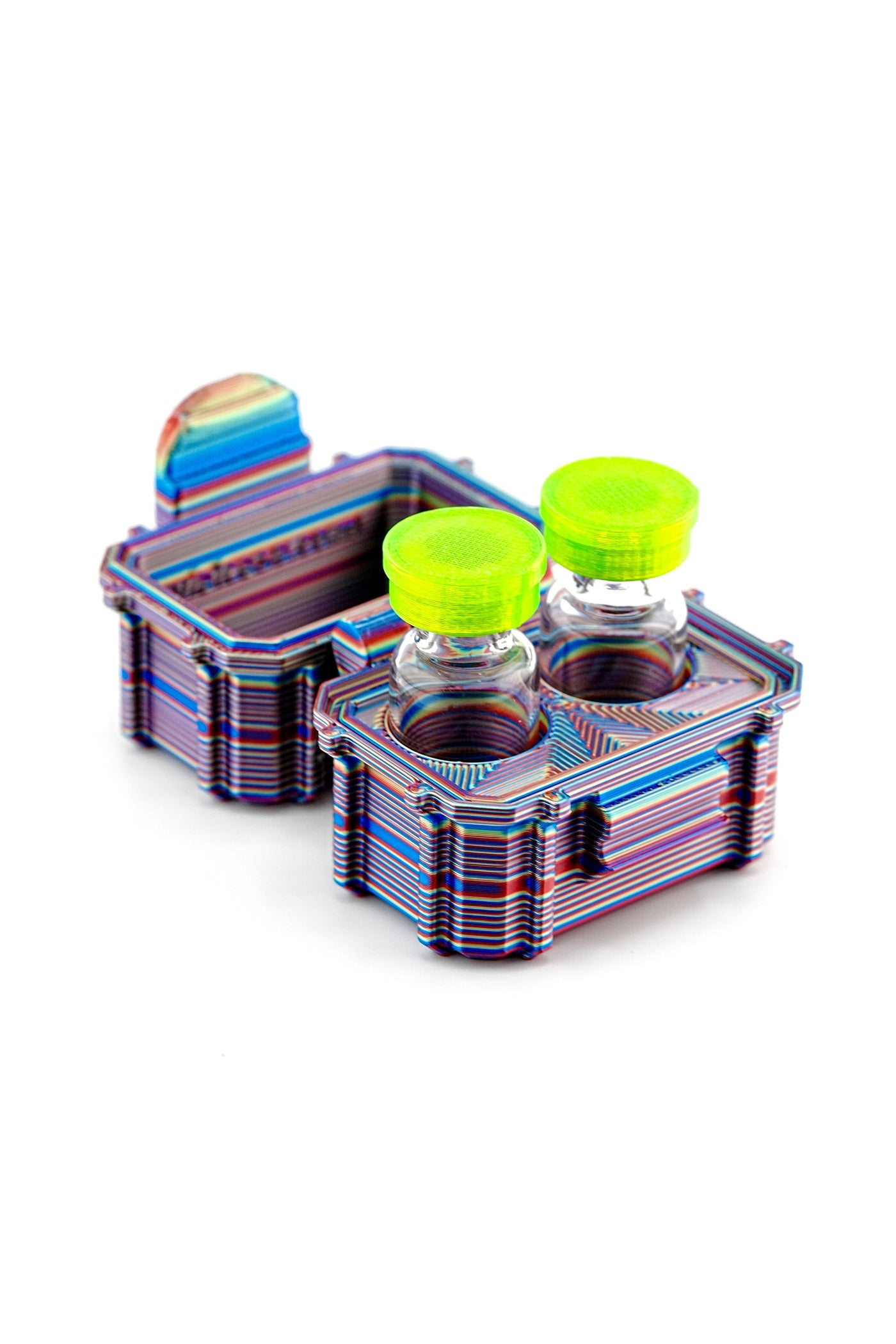
Vialcase produces hard-shell vial cases sized for GLP-1 pens, peptide vials, BAC water bottles, and reconstitution supplies. Three options most commonly referenced for travel:


Browse all vial storage cases →
Disclaimer
This article is informational reference only on documented National Park policies and amenities. It is not medical or legal advice. Refer to manufacturer prescribing information, NPS park-specific information, and a licensed healthcare provider for guidance.
Find your perfect case
Hard-shell, dust-free storage for every vial size. Made to order and backed by our 30-day guarantee.
Shop All Cases →