Theme Park GLP-1 & Peptide Travel Hub: Disney, Universal, Six Flags & More (2026)
Updated on: 2026-05-08
Table of Contents
🧮 Plan dose dates around your park visit
Theme park trips span 3–14 days typically. The free GLP1 Calculator's Titration Schedule maps weekly doses against your park itinerary — useful for tracking pre-trip injections, in-park days, and travel days.
📈 Track your weekly doses across the trip
The free GLP-1 Plotter logs each dose date and builds a plasma-level curve — useful for visualizing where each injection falls during your trip and confirming you don't miss a week.
- Shared Framework Across Parks
- Per-Park Documented References
- Summer Heat Profile by Region
- Universal Day-Bag Reference
- First Aid Center Cold Storage (How It Works)
- Hotel Mini-Fridge Profile by Tier
- Ride Lockers Across Park Operators
- Water Parks: Special Considerations
- Brand-Name GLP-1 Storage Windows
- Travel Gear Reference
- FAQ
- Disclaimer
Shared Framework Across Parks
Despite different operators, all major North American theme parks share a common framework for handling guests with injectable medications:
- Bag-friendly security screening. Every major park documents medical exemption for prescription medications, syringes, BAC water, and cold packs at park entrance security.
- First Aid Centers with refrigerated medication storage at every major park.
- Sharps disposal containers available through First Aid or hotel housekeeping.
- Cooler bags generally permitted (soft-sided; size limits vary by park).
- Disability access programs (DAS at Disney, AAP at Universal Hollywood, IAC at Universal Orlando, AAP at Six Flags) document return-time queue accommodations for guests with medical conditions affecting standing in extended queues.
Documentation requirements at park-entry security are minimal — original packaging is the documented standard, with prescription documentation as supporting backup if questions arise. Park Team Members across all major operators don't document a requirement for medical proof for First Aid medication storage requests.
Per-Park Documented References
For documented details on specific parks:
- Walt Disney World Resort — Magic Kingdom, EPCOT, Hollywood Studios, Animal Kingdom, Typhoon Lagoon, Blizzard Beach.
- Disneyland Resort — Disneyland Park, Disney California Adventure, Downtown Disney.
- Universal Orlando Resort — Universal Studios Florida, Islands of Adventure, Volcano Bay, Epic Universe.
- Universal Studios Hollywood — Studio Tour, Upper Lot, Lower Lot.
- Six Flags chain — 27 parks including Magic Mountain, Great Adventure, Cedar Point, Knott's, Kings Island, Carowinds, Canada's Wonderland, etc.
Summer Heat Profile by Region
Documented temperature ranges across major theme park regions in summer (June–September):
- Central Florida (Walt Disney World, Universal Orlando) — daily highs 92–96°F (33–36°C); heat index frequently 100°F+ (38°C+). Direct sun on park pavement exceeds 130°F (54°C). Highest documented heat exposure for park-day medication storage.
- Texas (Six Flags Over Texas, Fiesta Texas) — daily highs 92–102°F (33–39°C); heat index 105°F+ (41°C+). Comparable to Florida in raw heat with less humidity.
- Inland Southern California (Six Flags Magic Mountain, Universal Hollywood Valley side) — daily highs 88–98°F (31–37°C); occasional 100°F+ heat events. San Fernando Valley traps heat more than coastal LA.
- Coastal California (Disneyland, Six Flags Discovery Kingdom, Knott's, Great America) — daily highs 78–88°F (26–31°C). Coastal-influenced; generally favorable for medication carry.
- Mid-Atlantic and Northeast (Six Flags Great Adventure, New England, America, Carowinds, Kings Dominion) — daily highs 78–95°F (26–35°C); humidity adds to perceived heat.
- Midwest (Cedar Point, Kings Island, Six Flags Great America, St. Louis, Worlds of Fun, Valleyfair) — daily highs 80–92°F (27–33°C); Lake Erie microclimate moderates Cedar Point.
- Pacific Northwest — daily highs 75–85°F (24–29°C); milder.
- Canada (Canada's Wonderland) — daily highs 78–88°F (26–31°C).
Documented in-use windows for branded GLP-1s — Ozempic® (56 days at room temp ≤86°F), Wegovy® (28 days), Mounjaro® and Zepbound® (21 days) — can be exceeded in summer day-bag conditions at the hotter regions (Florida, Texas, inland California).
Universal Day-Bag Reference
Documented day-bag elements that work across all major theme parks:
- Insulated case with hard outer shell — protects vials from impact during walking, ride lockers, and stroller storage. Hard shell blocks light (documented light-protection element of GLP-1 storage).
- Pre-frozen gel packs (or phase-change packs) — gel packs typically maintain 2–8°C for 4–8 hours depending on insulation. Phase-change packs designed for the 2–8°C range specifically are documented as ideal for hot regions.
- Original packaging — Novo Nordisk Ozempic® / Wegovy® carton or Eli Lilly Mounjaro® / Zepbound® carton. Compounding pharmacy label for compounded GLP-1s. Supports light protection and identification at security.
- Sharps container — small portable model. Park First Aid disposes of sharps; hotel housekeeping accommodates.
- Backup pen needles — standard travel practice is 2–3× expected count for the trip duration.
- Prescription documentation — copy of prescription or physician letter, useful at security if questions arise.
First Aid Center Cold Storage (How It Works)
Across Disney, Universal, and Six Flags parks, First Aid medication storage operates on the same general framework:
- Drop-off in the morning. Bring the medication in its original packaging or insulated case to First Aid early in the day. Team Member tags the medication with name and contact info.
- Mid-day visits permitted. Guests can return any time during First Aid hours to retrieve medication for dose timing or self-administration on-site.
- Pickup at exit. Standard practice is collecting medication at end of day before leaving the park.
- Refrigeration profile. First Aid refrigerators are documented as suitable for the 2–8°C range needed for branded GLP-1s. Documented as similar to home refrigeration; not pharmaceutical-grade temperature-mapped storage.
- No charge. Documented as a free service across all major parks.
Hotel Mini-Fridge Profile by Tier
Documented mini-fridge availability across major theme park hotels:
- Disney-owned resort hotels — in-room refrigerators in all standard rooms across Value, Moderate, and Deluxe tiers at WDW, plus all three Disneyland Resort hotels. DVC Villas include full kitchens or kitchenettes.
- Universal Orlando on-site hotels (10 properties) — in-room refrigerators in all standard rooms across Premier, Preferred, and Prime Value tiers.
- Universal Hollywood partner hotels (Hilton Universal City, Sheraton Universal) — in-room refrigerators standard.
- Six Flags partner hotels — varies by park; documented practice is confirming refrigerator availability at booking.
- Off-site hotels generally — mini-fridge availability varies. Documented practice for temperature-critical medication is selecting a hotel where in-room refrigeration is confirmed.
All in-room refrigerators are documented as suitable for personal medication cooling but not pharmaceutical-grade. For pharmaceutical-grade conditions, hotel concierge can typically arrange access to property pharmacy or off-site pharmacy storage.
Ride Lockers Across Park Operators
Documented ride locker policies vary substantially by operator:
- Disney parks — relatively lenient. Many attractions allow loose items in seat pouches or under the seat. Free in-queue lockers at select coasters (Rock 'n' Roller Coaster, Slinky Dog Dash, Tron, Cosmic Rewind, Avatar Flight of Passage). Paid all-day lockers near park entrances.
- Universal Orlando and Hollywood — strict. Most coasters and high-intensity attractions require all loose items including bags in lockers. Lockers free for ride duration; sized for typical bags.
- Six Flags chain — strictest. Pockets must be empty on most coasters; bags, phones, wallets, keys all in lockers. Locker rentals typically paid hourly or all-day. Some parks include free short-term lockers at ride entrance.
None of the standard ride lockers are climate-controlled. Documented practice for temperature-sensitive medication during ride sessions is First Aid storage rather than lockers across all operators.
Water Parks: Special Considerations
Major theme park water parks (Typhoon Lagoon, Blizzard Beach, Volcano Bay, Hurricane Harbor parks) document the following amenities relevant to GLP-1 and peptide travel:
- First Aid Stations at park entrances with refrigerated medication storage.
- Locker rentals in multiple sizes; ambient temperature, not refrigerated.
- Cabana rentals (premium add-on) include lockable shaded space; some include a small fridge.
- Coolers permitted — small soft-sided coolers documented as permitted at most water parks (no glass, alcohol restrictions vary).
Documented practice for water park days is leaving the medication at the on-site hotel fridge or storing at water park First Aid Center for the day.
Brand-Name GLP-1 Storage Windows
The shared documented temperature profile across major GLP-1 medications during theme park travel:
- Refrigeration (2–8°C / 36–46°F) — the labeled cold-chain range. Most cruise/hotel fridges and theme park First Aid refrigerators sit comfortably in this range.
- Room-temperature ceiling (30°C / 86°F) — the upper limit for branded GLP-1s without active cooling.
- Documented in-use windows after first use: Ozempic® 56 days; Wegovy® 28 days; Mounjaro® and Zepbound® 21 days. Compounded semaglutide and tirzepatide vials follow the BUD on the pharmacy label, typically 28–60 days refrigerated.
- Freezing — not documented in any major GLP-1 manufacturer's labeling.
Travel Gear Reference
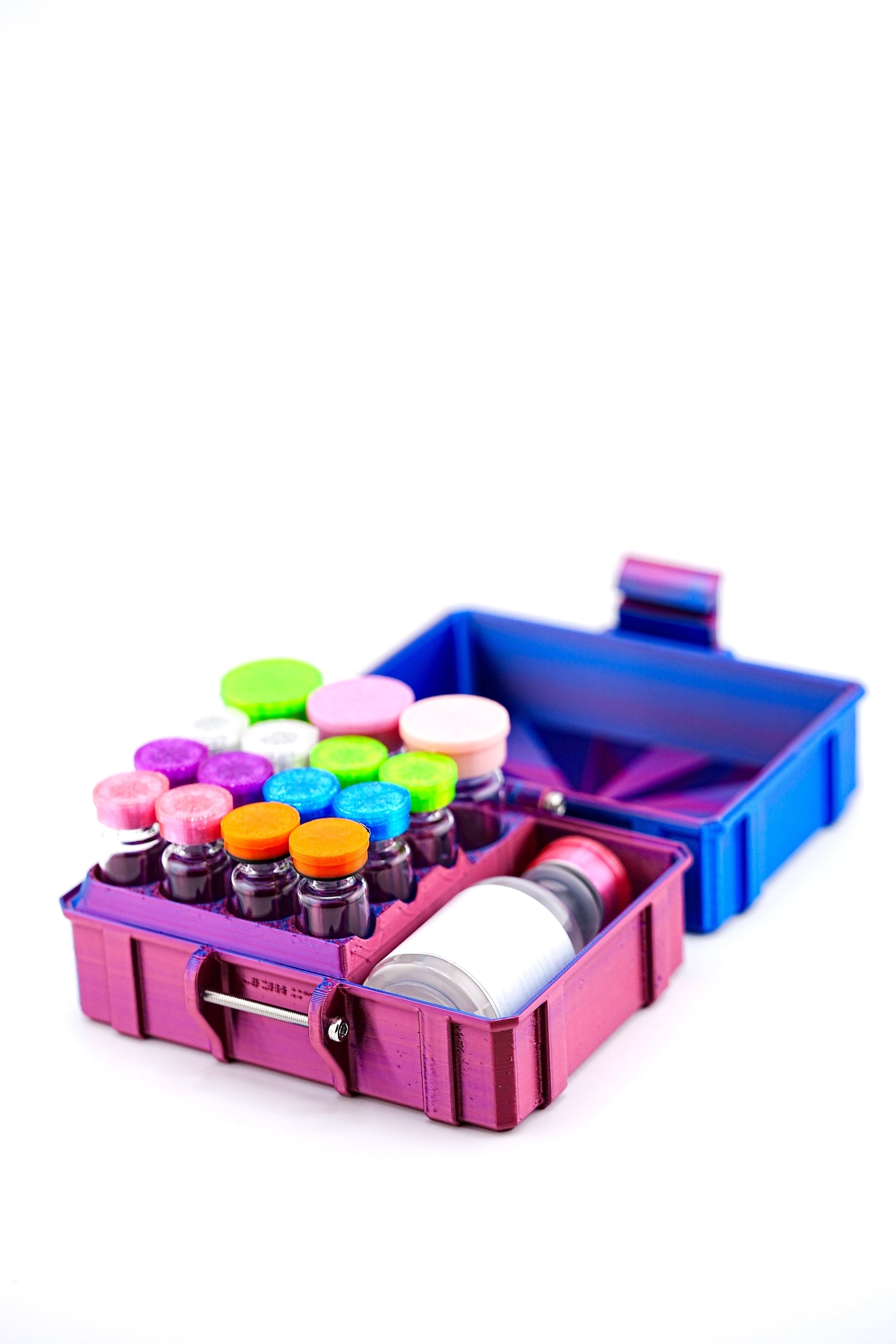
Vialcase produces vial cases sized for theme park day-bag carry-on, with slots for GLP-1 pens, peptide vials, BAC water bottles, and the syringes and alcohol pads in a typical reconstitution kit.


Browse all vial storage cases →
FAQ
Do major theme parks allow GLP-1 medications into the parks?
Yes, universally. Disney, Universal, and Six Flags all document medical exemption for prescription medications including injectable GLP-1s, peptide vials, BAC water, syringes, and cold packs at park-entrance security.
Do all major theme parks have refrigerated medication storage?
Yes. Every major theme park documents at least one First Aid Center with refrigerated medication storage as a free service.
Which theme park has the strictest ride locker policy?
Six Flags chain parks document the strictest policy — pockets must be empty on most coasters; bags, phones, wallets, keys all in lockers. Universal Orlando and Hollywood are next strictest. Disney parks document the most lenient policy, allowing many loose items in seat pouches.
What is the documented best practice for medication during theme park ride sessions?
Across Disney, Universal, and Six Flags, the documented best practice for temperature-sensitive medication during ride sessions is First Aid Center storage rather than ride lockers. Ride lockers are not climate-controlled.
Where are theme park trips highest-risk for GLP-1 storage temperature exposure?
Documented highest-risk regions are central Florida (WDW, Universal Orlando), Texas (Six Flags), and inland Southern California (Magic Mountain, Universal Hollywood Valley side). Daily summer highs and direct-sun pavement temperatures routinely exceed the 86°F (30°C) ceiling for branded GLP-1s.
Trademark notice: Walt Disney World®, Disneyland®, EPCOT®, Magic Kingdom®, Disney's Hollywood Studios®, Disney's Animal Kingdom®, Typhoon Lagoon®, Blizzard Beach®, and related Disney marks are trademarks of Disney Enterprises, Inc. Universal Studios®, Universal Orlando Resort®, Universal Studios Hollywood®, Islands of Adventure®, Volcano Bay®, Epic Universe, and related Universal marks are trademarks of Universal City Studios LLC. The Wizarding World of Harry Potter™ and Harry Potter™ are trademarks of Warner Bros. Entertainment Inc. Super Nintendo World™ is a trademark of Nintendo Co., Ltd. Six Flags®, Cedar Point®, Knott's Berry Farm®, Kings Island®, Carowinds®, Canada's Wonderland®, Hurricane Harbor®, and related marks are trademarks of Six Flags Entertainment Corporation. Ozempic® and Wegovy® are registered trademarks of Novo Nordisk A/S. Mounjaro® and Zepbound® are registered trademarks of Eli Lilly and Company. Vialcase is independent and is not affiliated with, endorsed by, or sponsored by any of the parks, manufacturers, or companies referenced in this article. References are descriptive of publicly available park documentation and manufacturer prescribing information.
Recommended Theme Park Travel Cases
Vialcase produces hard-shell vial cases sized for theme park day-bag carry-on, with slots for GLP-1 pens, peptide vials, BAC water bottles, and the syringes and alcohol pads in a typical reconstitution kit. Three options most commonly referenced for park days:
Browse all vial storage cases →
Disclaimer
This article is informational reference only on documented theme park policies for medical accommodations and the documented storage profile for GLP-1 medications. It is not medical or legal guidance and does not direct any specific clinical action. Verify current policy details directly with the specific theme park before visit and refer to manufacturer prescribing information and a licensed healthcare provider for clinical guidance.
Find your perfect case
Hard-shell, dust-free storage for every vial size. Made to order and backed by our 30-day guarantee.
Shop All Cases →