GLP-1 Surgery & Anesthesia Prep: ASA Guidelines, Hold Periods, and Pre-Op Reference (2026)
Updated on: 2026-05-08
Table of Contents
🧮 Plan dose timing around procedure dates
The free GLP1 Calculator's Titration Schedule helps map weekly dose dates against scheduled procedures — useful for visualizing the documented hold period before surgery.
- Why GLP-1s matter for anesthesia
- ASA documented guidance (2023–2024)
- Documented hold periods by medication and indication
- Colonoscopy-specific considerations
- Dental and oral surgery
- Cosmetic and elective surgery
- Orthopedic and major surgery
- Emergency surgery context
- Post-procedure GLP-1 resumption
- FAQ
- Disclaimer
1) Why GLP-1s matter for anesthesia
GLP-1 receptor agonists slow gastric emptying as part of their mechanism of action. This documented pharmacological effect is the basis for surgical and anesthesia concern: a patient on a GLP-1 medication may have residual gastric contents even after standard NPO (nothing by mouth) fasting periods, increasing the documented risk of aspiration during anesthesia induction.
Documented case reports beginning in 2022 described GLP-1 patients with retained gastric contents on endoscopy and intubation, despite following standard NPO guidelines. These reports drove the development of GLP-1-specific guidance from major anesthesia societies.
2) ASA documented guidance (2023–2024)
The American Society of Anesthesiologists (ASA) published documented guidance in June 2023, updated October 2024:
- 2023 Initial Guidance: ASA recommended holding GLP-1 medications for 1 week before elective procedures requiring anesthesia (for once-weekly dosing) or 1 day (for daily-dosed forms like oral semaglutide).
- 2024 Updated Guidance: ASA, the American Gastroenterological Association (AGA), and other societies published a joint multi-society statement refining the approach. The 2024 update referenced a case-by-case assessment rather than a strict 1-week universal hold, considering individual risk factors (GI symptoms, dose, duration of treatment) and procedure type.
The 2024 multi-society statement is documented as the current reference standard for elective procedures. It permits gastric ultrasound or point-of-care ultrasound to assess gastric contents in higher-risk patients and supports continuing GLP-1 therapy when residual gastric contents can be confirmed minimal.
3) Documented hold periods by medication and indication
Documented practice across surgical centers and the ASA/AGA guidance:
- Once-weekly GLP-1s (Ozempic®, Wegovy®, Mounjaro®, Zepbound®) — typical documented hold period is 1 week before elective surgery requiring general anesthesia or deep sedation. Some centers reference holding 2 weeks for higher-risk procedures.
- Daily oral semaglutide (Rybelsus®) — documented hold period is 1 day before procedure.
- Compounded weekly GLP-1s — same 1-week documented framework as branded weekly pens, since the active molecule and pharmacokinetics are identical.
The 1-week documented hold period reflects the long elimination half-life of weekly GLP-1s (semaglutide ~5 days; tirzepatide ~5 days). After 1 week, plasma concentrations are documented as substantially reduced but not zero.
4) Colonoscopy-specific considerations
Colonoscopy is the most common procedure documented in GLP-1 anesthesia case reports, partly because of high case volume and partly because of the bowel-prep workflow:
- AGA guidance documents holding GLP-1 for 1 week before colonoscopy with sedation, particularly for patients with GI symptoms or recent dose escalation.
- Bowel preparation typically begins 1–2 days pre-procedure and may be more challenging on a delayed-emptying baseline. Some endoscopy centers document extending the bowel prep by 24 hours for GLP-1 patients.
- Aspiration risk during sedation is the primary documented concern. Several case series reported retained gastric contents on colonoscopy intubation despite standard fasting.
5) Dental and oral surgery
Documented considerations for dental procedures:
- Local anesthesia only — routine dental work with local anesthesia is documented as not requiring GLP-1 hold. The aspiration risk concern applies to deep sedation, not local anesthesia.
- Conscious sedation (oral or IV) — documented practice references the ASA guidance. Many oral surgeons document holding GLP-1 for 1 week before procedures involving IV sedation.
- General anesthesia for oral surgery (impacted wisdom teeth, jaw surgery) — same 1-week hold framework as other surgical procedures.
6) Cosmetic and elective surgery
Cosmetic surgery centers document specific GLP-1 protocols:
- Liposuction, abdominoplasty, breast surgery — typically performed under general anesthesia. Documented practice is 1-week GLP-1 hold per ASA/multi-society guidance.
- Patient population overlap — documented as significant. Cosmetic surgery centers report high GLP-1 prevalence in their patient population (estimated 20–40% of bariatric and cosmetic patients on weight-management GLP-1s as of 2025–26).
- Pre-op consultation documents the GLP-1 question explicitly. Patients are documented as proactively disclosing GLP-1 use during the pre-surgical consult.
7) Orthopedic and major surgery
Documented considerations for major surgery:
- Joint replacement (knee, hip) — standard 1-week GLP-1 hold per ASA framework.
- Spine surgery — same framework.
- Cardiac, abdominal, oncologic surgery — same framework. Documented practice for emergency cases is more nuanced (see next section).
- Bariatric surgery — specific documented protocols. Many bariatric programs document discontinuation 2 weeks pre-op given the combination of GLP-1 + bariatric surgery's dual effects on gastric anatomy.
8) Emergency surgery context
Documented practice when surgery cannot be electively scheduled:
- Emergency or urgent surgery in a GLP-1 patient is documented as proceeding with assumed full stomach precautions — rapid sequence intubation, aspiration prophylaxis, and modified anesthesia approach.
- Gastric ultrasound at the bedside is documented in some centers as a tool to assess residual gastric contents and tailor the airway approach.
- NPO timing remains important even with GLP-1 hold concerns; the standard NPO guidelines (typically 6–8 hours for solids, 2–4 hours for clear liquids) still apply.
9) Post-procedure GLP-1 resumption
Documented practice for restarting GLP-1 after surgery:
- Once nausea, vomiting, and ileus risk have resolved — typically several days to 1–2 weeks post-op depending on procedure.
- Restart at the previous maintenance dose if the hold period was less than 4 weeks. For longer holds (more than 4 weeks), documented practice references restarting titration from a lower dose.
- Coordinate with surgical and prescribing team — the GLP-1 prescriber and surgeon both have a role in the timing decision.
10) FAQ
How long should I stop my GLP-1 before surgery?
The current ASA / multi-society documented guidance references a 1-week hold for once-weekly GLP-1 medications before elective surgery requiring anesthesia. The 2024 update permits a case-by-case assessment, particularly when gastric ultrasound or other tools can confirm minimal residual gastric contents. The decision is documented as one for the patient's prescribing physician and surgical team.
Does the same hold period apply to colonoscopy?
Documented gastroenterology guidance references the same 1-week hold for GLP-1 before colonoscopy with sedation. Some endoscopy centers document additional bowel-prep extension for GLP-1 patients given the delayed-emptying baseline.
What if I forgot to stop my GLP-1 before surgery?
Documented practice when GLP-1 wasn't held appropriately is for the surgical team to consider rescheduling the elective procedure or proceed with full-stomach precautions (rapid sequence intubation, aspiration prophylaxis). This decision is documented as one for the anesthesia and surgical team based on individual risk-benefit assessment.
Does local-anesthesia dental work require holding GLP-1?
Documented practice references local-anesthesia-only dental procedures (routine fillings, cleanings) as not requiring GLP-1 hold. The aspiration concern applies to deeper sedation. IV-sedation dental procedures follow the standard 1-week hold framework.
When can I restart my GLP-1 after surgery?
Documented practice references restarting GLP-1 once nausea, vomiting, and ileus risk have resolved — typically several days to 1–2 weeks post-op. The exact timing is documented as a decision for the prescribing physician and surgical team. Patients held for less than 4 weeks typically resume at their previous maintenance dose; longer holds may require re-titration from a lower starting dose.
Trademark notice: Ozempic®, Wegovy®, and Rybelsus® are registered trademarks of Novo Nordisk A/S. Mounjaro® and Zepbound® are registered trademarks of Eli Lilly and Company. The American Society of Anesthesiologists® (ASA) and American Gastroenterological Association® (AGA) are registered marks of their respective organizations. Vialcase is independent and is not affiliated with, endorsed by, or sponsored by ASA, AGA, Novo Nordisk, Eli Lilly, or any surgical society. References are descriptive of publicly available society guidance documents.
Recommended Travel Cases
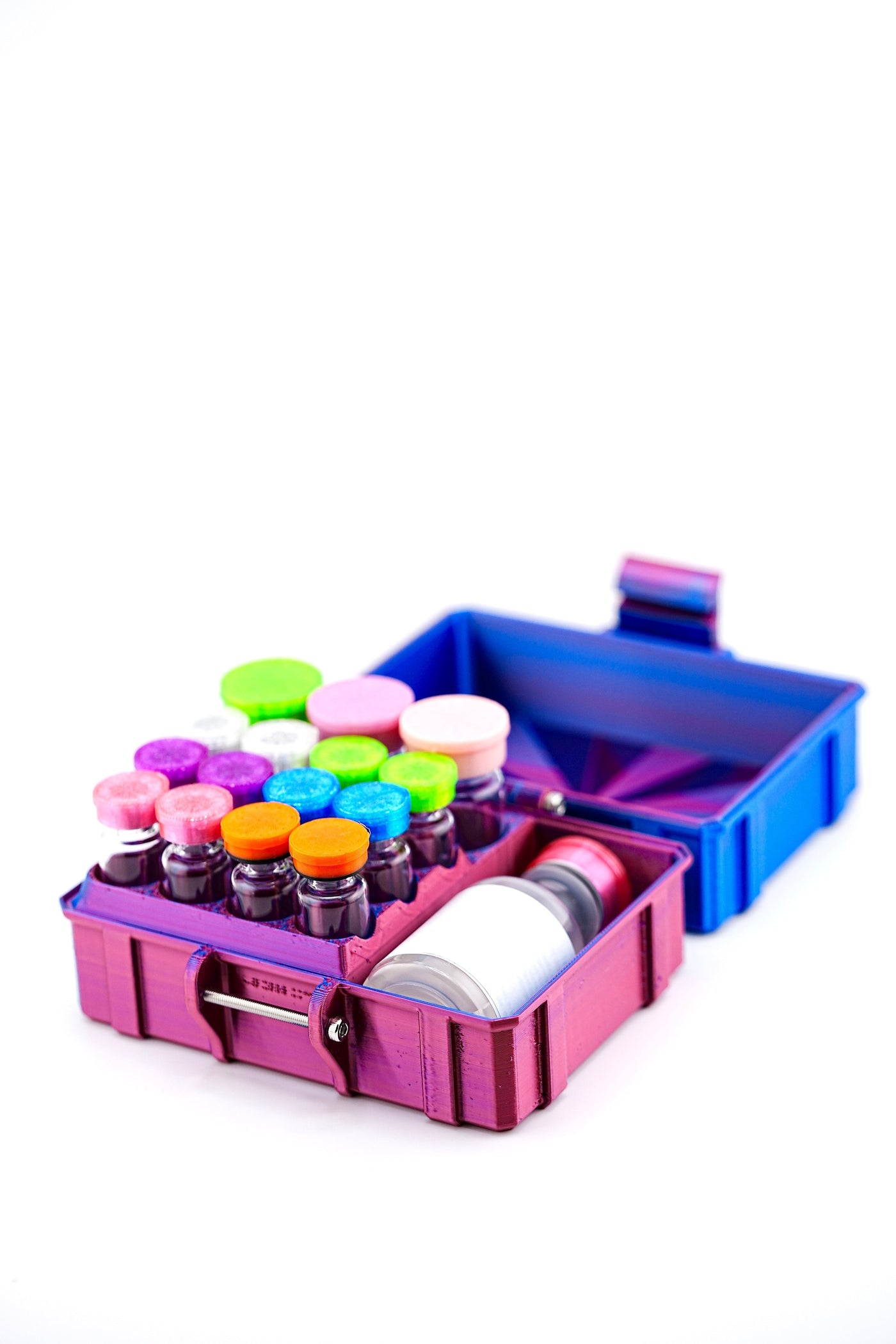
Vialcase produces hard-shell vial cases sized for GLP-1 pens, peptide vials, BAC water bottles, and reconstitution supplies. Three options most commonly referenced for travel:


Browse all vial storage cases →
Disclaimer
This article is informational reference only on documented ASA, AGA, and multi-society guidance for GLP-1 medications and surgery/anesthesia. It is not medical or legal advice and does not direct any specific clinical action. Decisions about pausing or continuing GLP-1 medication before any procedure must be made with the patient's prescribing physician and surgical/anesthesia team. The published guidance continues to evolve; verify current society recommendations at the time of any procedure.
Find your perfect case
Hard-shell, dust-free storage for every vial size. Made to order and backed by our 30-day guarantee.
Shop All Cases →