GLP-1 Pen vs Vial: Storage, Travel, Dose Flexibility, and Cost Compared (2026)
Updated on: 2026-05-08
Table of Contents
🧮 Vial dose math reference
Vial format requires reconstitution math. The free GLP1 Calculator handles vial mg + BAC mL + concentration + U100 syringe units in one tool.
- The format landscape
- Storage profile
- Dose flexibility
- Travel logistics
- Required supplies and inventory
- Sharps disposal volume
- Documented error rates
- Cost and access
- Side-by-side reference table
- FAQ
- Disclaimer
1) The format landscape
Documented GLP-1 format options:
- Multi-dose pre-filled pen — Ozempic® (4 doses per pen). The pen is reused weekly until empty.
- Single-use pre-filled pen — Wegovy®, Mounjaro®, Zepbound® (1 dose per pen). The pen is disposed after delivery.
- Single-dose vial (branded) — Zepbound® vial format (introduced 2024). Tirzepatide in solution. Patient draws the dose with a syringe.
- Multi-dose vial (compounded) — compounded semaglutide or tirzepatide, supplied as lyophilized powder. Patient reconstitutes with BAC water, then draws individual weekly doses with U100 insulin syringes.
Each format has documented tradeoffs in convenience, cost, storage, and dose flexibility.
2) Storage profile
Documented storage profile by format:
- Multi-dose pen (Ozempic) — 2–8°C before first use; 56 days at room temp ≤86°F after first injection.
- Single-use pen (Wegovy) — 2–8°C before use; 28 days at room temp ≤86°F.
- Single-use pen (Mounjaro/Zepbound) — 2–8°C before use; 21 days at room temp ≤86°F.
- Single-dose vial (Zepbound) — 2–8°C before use; 21 days at room temp ≤86°F (matching the pen format).
- Multi-dose compounded vial, lyophilized — pre-reconstitution: refrigerated; pharmacy-labeled BUD typically 90–180 days.
- Multi-dose compounded vial, post-reconstitution — refrigerated 2–8°C continuously; pharmacy-labeled BUD typically 28–60 days.
The pen formats document the most generous room-temperature flexibility. Vial formats — especially compounded post-reconstitution — reference stricter continuous refrigeration.
3) Dose flexibility
Documented dose flexibility by format:
- Multi-dose pen (Ozempic) — dose dial supports the prescribed dose; not freely adjustable beyond the dose options of the specific pen strength.
- Single-use pen (Wegovy/Mounjaro/Zepbound) — pre-set to the labeled dose; no patient adjustment.
- Single-dose vial (Zepbound) — vial contains the labeled dose; patient draws the full vial contents.
- Multi-dose compounded vial — fully dose-flexible. The patient can draw any dose at any time using the U100 syringe. Documented practice for "microdosing" (sub-clinical doses below standard 0.25 mg starting dose) is exclusively via the multi-dose vial format.
Dose flexibility is documented as the major reason some patients choose the multi-dose vial format despite its workflow complexity — they can titrate in finer increments (e.g., 0.1 mg increments) or sustain non-standard doses based on individual response.
4) Travel logistics
Documented travel implications:
- Multi-dose pen (Ozempic) — lowest pen count for travel. One pen typically covers 4 weekly doses.
- Single-use pens (Wegovy/Mounjaro/Zepbound) — one pen per weekly dose. More inventory to carry and dispose during travel.
- Single-dose vial (Zepbound) — vial + syringe per weekly dose. Slightly more compact than pens but requires the syringe in carry-on inventory.
- Multi-dose compounded vial — one vial covers 4–5 weekly doses, similar to Ozempic. But adds BAC water bottle, U100 syringes, alcohol pads, and sharps container to travel inventory. Reconstitution before trip; refrigeration during.
For TSA carry-on, all formats fall under the medical-liquids exemption.
5) Required supplies and inventory
Documented supply inventory by format:
- Pen formats — pen + pen needles + sharps container. Typical monthly supply: 4 pens (single-use) or 1 pen (multi-dose Ozempic), plus 4–6 pen needles.
- Single-dose vial (Zepbound) — vial + syringe + sharps container. Typical monthly supply: 4 vials, 4 syringes (Eli Lilly supplies the syringes with the vial order), plus alcohol pads.
- Multi-dose compounded vial — vial + BAC water bottle + U100 insulin syringes (4–5 per vial) + alcohol pads + sharps container. Typical monthly supply: 1 vial, 1 BAC water bottle (covers multiple vials), 4–5 U100 syringes, alcohol pads, sharps container.
The compounded multi-dose vial generates the most ancillary supply complexity but the lowest medication-cost-per-month. Pens are the simplest supply chain.
6) Sharps disposal volume
Documented sharps generation per month:
- Multi-dose pen (Ozempic) — 4 pen needles + 1 used pen (every ~4 weeks). Lowest sharps volume.
- Single-use pens — 4 used pens per month. Highest sharps volume.
- Vial formats (branded vial or compounded) — 4 syringes + 4 alcohol pads per month. Moderate sharps volume.
Sharps volume is documented as a practical consideration for travel (cruise stateroom sharps bins) and at-home storage.
7) Documented error rates
Documented dosing-error potential by format:
- Pen formats — lowest documented dose-error rate. The dose is dialed (Ozempic) or pre-set (single-use pens). Limited room for measurement error.
- Vial formats — require the patient to draw the correct dose with a U100 syringe. Documented dose-error scenarios include: misreading syringe markings (mistaking 30 units for 3 units), drawing the wrong volume after a calculation error, or reconstituting with the wrong BAC water volume.
The free GLP1 Calculator is documented as one tool for reducing dose-calculation errors with vial formats by computing exact mg-to-units conversion.
8) Cost and access
Documented monthly cost by format:
- Branded pens — $1,000–$1,600/month retail.
- Zepbound vial via LillyDirect — $349–$499/month.
- Compounded vial — $200–$500/month historically (varies by pharmacy and dose).
The cost differential is documented as the major driver of vial-format adoption.
9) Side-by-side reference table
| Property | Pen formats | Vial formats |
|---|---|---|
| Preparation | Inject (~30 sec) | Reconstitute + draw + inject (~3 min) |
| Dose flexibility | Pre-set | Fully flexible (compounded multi-dose) |
| Travel inventory | Pen + needles | Vial + BAC water + syringes + sharps |
| Sharps/month | 4 pens or 4 needles | 4 syringes + 1 vial |
| Dose-error potential | Low | Higher (calculation-dependent) |
| Storage flexibility | 21–56 days room temp | Continuous refrigerated |
| Monthly cost | $1,000–$1,600 | $200–$499 |
| FDA-approved options | Ozempic, Wegovy, Mounjaro, Zepbound | Zepbound vial (branded); compounded |
10) FAQ
Which is easier to use: pen or vial?
Pen formats are documented as more convenient for routine use — pre-filled, pre-set or dialed dose, ~30 second workflow. Vial formats require reconstitution and dose drawing, adding ~2–3 minutes per injection plus the cognitive step of dose calculation.
Which is better for travel: pen or vial?
Pen formats are documented as more travel-friendly — fewer ancillary supplies, longer room-temperature windows, no reconstitution required. Multi-dose pens (Ozempic) carry the lowest travel inventory.
Why do some patients choose vial formats?
Two main documented reasons: lower cost (compounded vials are 4–6× cheaper than branded pens) and dose flexibility (multi-dose vials support custom doses including microdosing not available with pre-set pens).
Are vial-format dose errors common?
Documented dose errors with vial formats include misreading syringe markings (e.g., drawing 30 units instead of 3), miscalculating reconstitution volumes, and confusing mg with units. The error rate is documented as higher than pen formats, particularly for new vial users. Reconstitution calculators are documented as one mitigation.
Can I switch between pen and vial format mid-treatment?
Patient switching between formats is documented in clinical literature. The decision is made with the prescribing healthcare provider. Documented practice when switching to a vial format from a pen format includes verifying the equivalent mg dose and confirming reconstitution math before first injection.
Trademark notice: Ozempic® and Wegovy® are registered trademarks of Novo Nordisk A/S. Mounjaro® and Zepbound® are registered trademarks of Eli Lilly and Company. LillyDirect™ is a service of Eli Lilly. Vialcase is independent and is not affiliated with, endorsed by, or sponsored by Novo Nordisk or Eli Lilly. References are descriptive of FDA-approved medications and publicly available manufacturer prescribing information.
Recommended Travel Cases
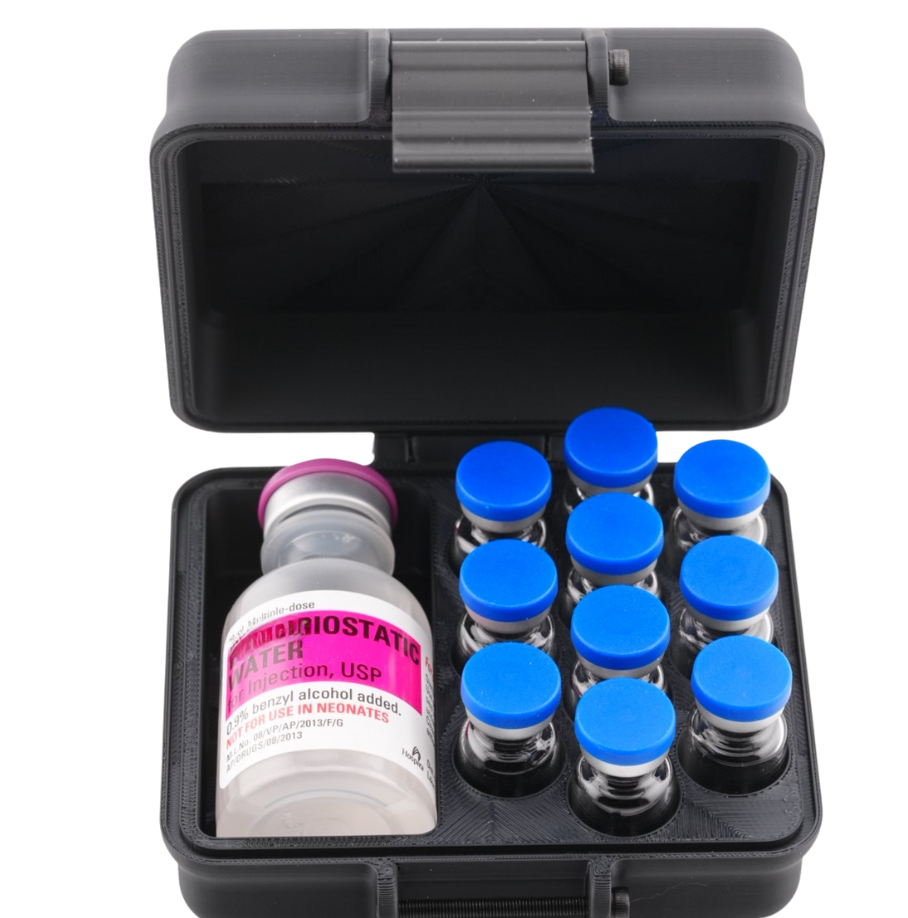
Vialcase produces hard-shell vial cases sized for GLP-1 pens, peptide vials, BAC water bottles, and reconstitution supplies. Three options most commonly referenced for travel:


Browse all vial storage cases →
Disclaimer
This article is informational reference only on documented format differences for GLP-1 medications. It is not medical or legal advice and does not direct any specific clinical action. Refer to manufacturer prescribing information and a licensed healthcare provider for clinical guidance specific to format selection and dosing.
Find your perfect case
Hard-shell, dust-free storage for every vial size. Made to order and backed by our 30-day guarantee.
Shop All Cases →